Visit this fun game, were you are able to create differnt objects using the four elements.
http://littlealchemy.com/
Thursday, March 22, 2012
Frog Dissection Response
In the lab, we dissected a non-living frog. We followed certain instructions and we had to indicate certain organs. We found fat bodies, liver, heart, lungs, gall bladder, stomach, small intestine, large intestine, spleen and the esophogus. Also, we had to identify organs and place them into the different systems. Finally, we didnt have to preform the dissection manually, as an option we could have done it online.
http://www.mhhe.com/biosci/genbio/virtual_labs/BL_16/BL_16.html
http://www.mhhe.com/biosci/genbio/virtual_labs/BL_16/BL_16.html
States Of Matter
In Class we have been learning about the different states of matter. Their are four different types of matter solids, liquids, gases, and plasma. Solids are objects with definite shape and definite volume. Liquids are fluids with definite volume and has no shape of its own. Gases are fluids that can move freely, with no definite shape or volume. Finally, plasma is matter that is found commonly in stars in space.
We have done labs in class that connect to matter. A lab we have done is where we observed the changes in certain materials. We roasted marshmellows to demonstrate the physical changes. In the Candle Lab we saw how Carbon Dioxide(made with Alka Seltzer and water) can blow out a flame. In another lab, we saw physical changes because the smaller & thinner candle melted faster than the big & fatter candle. Finally, in the Sugar Lab we watched how the physical and chemical properties of the sugar were changed.
Finally, I learned that everything is made up of matter and that everything is impacted in a chemical or physical way.
We have done labs in class that connect to matter. A lab we have done is where we observed the changes in certain materials. We roasted marshmellows to demonstrate the physical changes. In the Candle Lab we saw how Carbon Dioxide(made with Alka Seltzer and water) can blow out a flame. In another lab, we saw physical changes because the smaller & thinner candle melted faster than the big & fatter candle. Finally, in the Sugar Lab we watched how the physical and chemical properties of the sugar were changed.
Finally, I learned that everything is made up of matter and that everything is impacted in a chemical or physical way.
Monday, January 9, 2012
Separating A Mixture
In our lab, we had to separate the materials given into seven groups, we also had to write a procedure (steps). Step 1, is to separate the toothpicks, beans, spider, and water from plastic cups onto your tray. Step 2, is to boil the sand, salt, and water in the beaker on the hot plate. Step 3, is to remove the beaker from the hot plate and to filter the sand, salt, iron filling from the water into the plastic cup. Step 4, is to place the magnet into the plastic cup to separate iron fillings from sand and salt. Step 5, is to place them into the seven possible groups, you should get 1.water, 2.beans, 3.spider,4. toothpicks , 5.salt, 6.sand, 7.iron fillings.
Thursday, December 1, 2011
Thursday, October 20, 2011
Chicken Wing Anatomy Lab
In our Lab Today we discussed and watched the dissection of a chicken wing. The purpose was to observe the dissection to learn and identify the different types of tissue and organs. We also had to pay attention of what color each item was, like the skin, muscle, ligament, and cartilage. We didn't find a nerve while we watched. In the lab the tissue that actually moved the chicken wing was the muscle. The role of the epithelial is to keep the muscle, cartilage, and ligaments protected. Also, the chicken wings are similar to human arms because in both the muscles allows the arm or wing to move. There different because in human bones the longer and there is more cartilage, in chicken wings the bones are shorter and there is less cartilage.
Monday, October 17, 2011
Sunday, October 16, 2011
Diffusion Lab Essay
Diffusion Essay
In Class we have been talking about diffusion and osmosis, and later we did a lab. The purpose of the lab was to see if we understood diffusion and osmosis. The definition of diffusion is the process by which molecules from an area of lower concentration. Therefore the definition of osmosis is diffusion of water molecules (H2O) though a selectivity semi permeable membrane. In the lab we had to put starch into a bag which represents organelles, and the bag represents the semi permeable cell membrane. Then we filled a beaker half way with water, and the added two or three drops of Iodine. The iodine represents an indicator and nutrients for the cell. The Iodine is hypertonic so it dilutes into the bag of starch. Soon the water becomes hypotonic, and the concentration is now isotonic. Our prediction was that the iodine would turn the starch purple.
My analysis of the lab is that for most of the experiments you have to wait a little longer for the starch to dilute the baggie. But after a while the starch inside the baggie turns a purple color. Sometimes for this project to work you have to have the right materials and the right brand of baggies. The problem with ours is that we didn’t have the right kind or brand of plastic baggies. In the procedure you are required to add starch to a baggie, add water and iodine into a beaker, and place closed baggie into beaker and watch how diffusion and osmosis works.
Also, some examples of diffusions and osmosis in life are in some restaurants sliced potatoes are soaked in water before they are fried. Also, Diffusion of gas particles enables smell, so flowers/fruit can attract animals/insects by scent leading to fertilization or dispersion of seed particles. Also, Osmosis is used in plants, and growing crops. Finally, diffusion is responsible for the movement of oxygen from carrying red blood cells to different cells. Osmosis carries nutrients from the circulatory system into the cells and water also is responsible for carrying dissolved wastes away from the cells.
Tuesday, October 11, 2011
Diffusion Lab Response
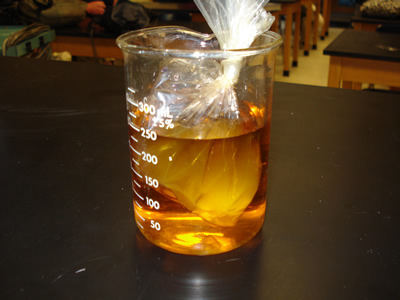 Our lab today involved us learning about diffusion and osmosis. Our assignment was to put a teaspoon of corn starch in a baggie with water. Then we had to fill a beaker half way with water, and then add the iodine. After 15 minutes the iodine is supposed to make the corn starch turn the same color as the solution or turn purple. For our group, ours worked partly. Only the bottom of the corn starch turned purple. Most of the time this should work. (Iodine can stain clothes and hair, please wear goggle and tie hair back if going this project)
Subscribe to:
Posts (Atom)